Research Conference in Singapore: Doing Business in the New Geopolitical World
Research Conference in Singapore: Doing Business in the New Geopolitical World
Following the inaugural Research Conference of the ESSEC Institute for Geopolitics & Business in Singapore, Srividya Jandhyala, Jamus Lim and Aurélien Colson reflect on this initiative and the key takeaways from the conference.
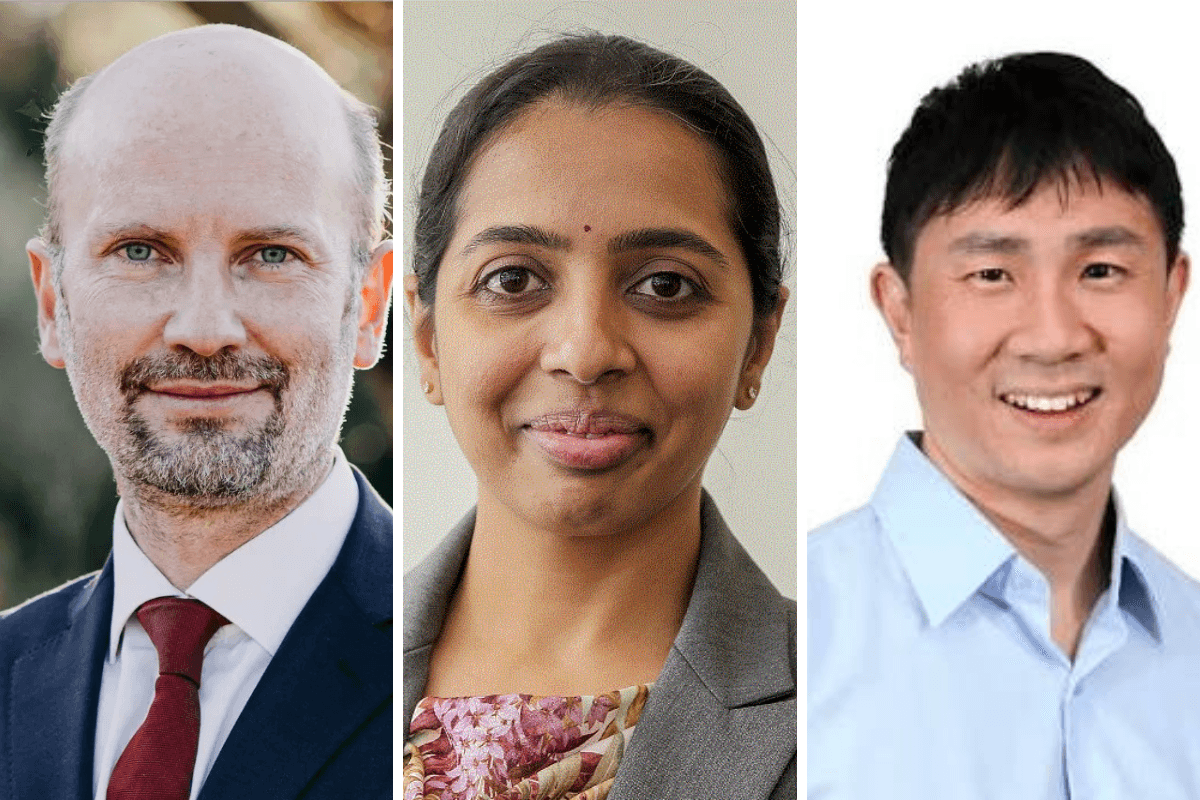
1- Aurélien, the ESSEC Institute for Geopolitics & Business chose Singapore for its first Research Conference. What is the core mission of this academic gathering in the current context of global fragmentation, defined by the Institute as the « post-globalization »?
Aurélien Colson - The choice of our Singapore campus was deliberate. First of all because we build upon the success of the previous BizGov research conferences organized by my colleagues Vidya and Jamus. Besides, in the post-globalization era, Asia is not only a major engine of growth; it is also where the new entanglement between geopolitics and business is most visible.
Our mission with this conference was therefore to move beyond the old question of whether geopolitics matters for business, and instead examine how business now operates within geopolitics. The program reflected that shift very clearly: sanctions, supply chains, semiconductors, AI governance, media trust, and cultural legitimacy all point to the same reality: firms must now navigate not only markets, but also power, security, and strategic dependence.
2- Srividya, you chaired the morning sessions on how geopolitics is reshaping global strategy and supply chains. As efficiency is no longer the sole metric of success for companies, what is the defining insight you draw from the presentations of the academic papers by Daniel Blake (IE Business School), Quan Li (Texas A&M University), Jian Xu (NUS) and Jaeyong Song (Seoul National University)?
Srividya JANDHYALA - The first session really set the stage for a deep discussion on the changes in the global system. Across these presentations, we learnt about how multinational firms’ global strategies are being reshaped. Geopolitics is changing the economic order, forcing firms to rethink their competitive advantages. Highlighting some surprising and unanticipated effects, researchers demonstrated the resilience of Huawei’s American suppliers despite rising geopolitical tensions. Others indicated how supply chains are evolving from efficiency to ‘realism’, and the adaptation of SMEs to prioritize politics over profits.
3- Jamus, you chaired the afternoon session where professors Kenneth Huang (NUS Business School), Jonathan Chu (Lee Kuan Yew School of Public Policy, NUS), Ruben Durante (NUS) and Caleb Tse (NTU Business School) presented their papers focused on the strategic friction between emerging technologies, institutional trust, and global market dynamics. Which core findings from these papers do you believe will most fundamentally change how leaders approach geopolitical risks in their economic strategy?
Jamus LIM - I think business leaders now need to enfold not only purely economic bottom-line calculations into their decisions, but also how political-economy pressures can complicate what it means when they weigh different options. For instance, corporations have clear economic incentives to favor rapid AI adoption and deployment. But they can no longer adopt a neutral stance to their counterparty suppliers; marginal calculations between costs and benefits will change if there is also a risk of technology sanctions, leaked proprietary data through corporate espionage, and supply-chain disruptions due to geopolitical conflict. Similarly, country-to-country trade and finance is no longer a simple matter of economic size and distance; geopolitical alignment will be a consideration, leading to more "friendshoring" of foreign investment and trade.
4- You co-coordinate the Faculty Guild for Geopolitics & Business, aimed at advancing research at this critical nexus. As a Management scholar, what essential questions did this conference provoke, and how will they shape the Guild’s research roadmap?
S.J. - All the researchers challenged scholars to think more deeply about how global companies can successfully compete in a world of rising tariffs, trade wars, export controls, conflicts, and national security considerations – all combined with rapid advances in AI. Which resources and skills will be most valuable for companies? How can these be leveraged to create value across multiple markets and even geopolitical faultlines? What are the implications for global supply chains and innovation? How should AI be adopted and regulated? A roadmap that puts these questions at the center of its research agenda will not only advance scholarship but also offer practitioners much needed guidance in navigating a fast-changing world.
5- As an Economics Professor, and co-coordinator of the Geopolitics & Business Guild, how will the key takeaways of this conference impact your research for the coming months?
J.L. - I think the conference underscores how geopolitics - and its close cousin, geoeconomics - are here to stay, and are important considerations for all levels of society, not least our businesses and corporate leaders. For a period in the 2000s, many policymakers believed that issues such as the political economy of trade or finance were passé, and only of academic interest. What we have learned in this decade is that they were merely dormant, and such forces are now returning to the fore. Developments on this front will thus inspire new research that best explains the phenomena we observe, and such research, in turn, will therefore inform the business community on how best to navigate this evolving global landscape.
6- This first edition of this Research Conference brought together a network of leading academics from Asia, North-America and Europe. Looking toward the years ahead, how will this shape the research priorities of the Geopolics & Business Guild?
A.C. - We’ll discuss this with our colleague Angela Sutan, too, as she is the co-coordinator of the Guild. Looking ahead, the Geopolitics & Business Guild could focus on strategic questions now becoming central to firms, regulators, and societies alike: how companies redesign trusted and resilient supply chains under conditions of coercion and fragmentation; how they adapt to sanctions, export controls, and investment screening; how AI, data governance, and technological sovereignty reshape competition; how critical minerals, semiconductors, and energy infrastructures become geopolitical chokepoints; and how firms preserve optionality when alliance politics, market access, and security logics increasingly collide. Sovereignty and defense issues will be central, which could have unprecedented consequences on how global business is being done.
Current academic agendas are clearly moving in this direction, with growing attention to political turbulence, economic statecraft, strategic resilience, and digital globalization. In this field, colleagues in the ESSEC Guild have all it takes to keep our business school at the research cutting edge, while deepening collaboration with like-minded scholars across Asia, Africa, America, and Europe.

ABOUT THE ESSEC INSTITUTE FOR GEOPOLITICS & BUSINESS
Created in 2024 by ESSEC, the Institute for Geopolitics & Business examines how geopolitical shocks reshape companies’ economic models.
Operating across ESSEC Business School’s campuses in France, Morocco, and Singapore, it brings a tri-continental perspective to what drives corporate competitiveness in the post-globalization era: vigilance, resilience, independence.
It feeds into ESSEC’s degree programs, executive education, and research to foster a new generation of geopolitics-proof business leaders capable of steering and growing companies amid an increasingly brutalized world.
Rooted in ESSEC’s academic excellence, the Institute draws on 4 flagship centers:
- the IRENE Center for Negotiation & Mediation,
- the Center for Geopolitics, Defense & Leadership,
- the Center for European Law & Economics, and
- the Chair Business & Industry in Africa.